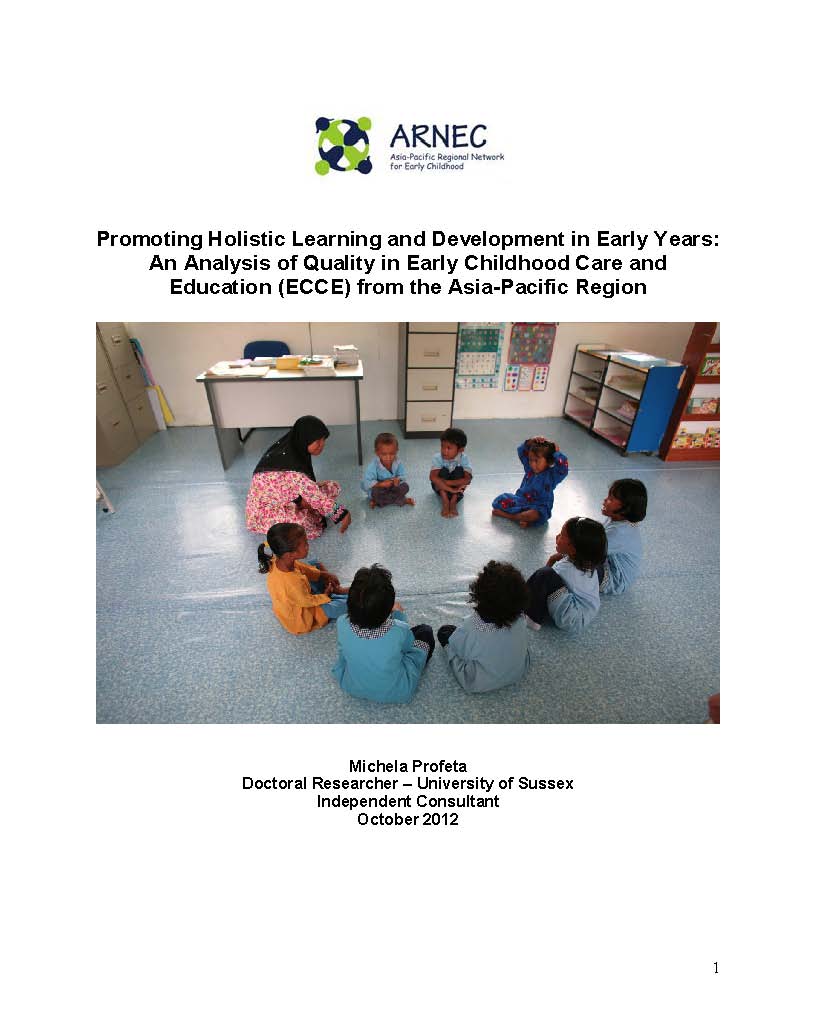
Promoting Holistic Learning and Development in Early Years: An Analysis of Quality in Early Childhood Care and Education (ECCE) from the Asia-Pacific Region
This paper focuses on the quality of Early Childhood Care and Education (ECCE) in the Asia Pacific region. In a recent report on EFA goal n.1, UNESCO and UNICEF give this definition of ECCE:
‘The term ‘early childhood care and education’ (ECCE) refers to a range of processes and mechanisms that sustain, support and aid the holistic development of children, from birth to age 8 years.’
(UNESCO et al., 2012)
In the introduction (chapter 3), arguments for an expansion of ECCE - particularly in developing countries – are presented in policies and programmes in the field of early learning and development, which advocates for the potential benefits on children’s later learning experiences and on their holistic development (UNESCO, 2006, Save the Children, 2009, ARNEC, 2011a, ARNEC, 2011b). Indeed research has demonstrated the gains that children can make by participating in programmes of ‘good’ quality, especially the underprivileged children, and it has been argued that ECCE can contribute to reaching the other EFA goals and MDGs. Therefore, ECD/ECCE can contribute to breaking the poverty cycle (Young, 2002, Consultative group on early childhood care and development, 2007, Naudeau et al., 2010), and a high return rate in investing in ECD which has been demonstrated (Young Lives, 2010, Engle et al., 2007a, Engle et al., 2007b, Young, 2002). This notwithstanding access is still very unequal (Arnold et al., 2007, UNESCO et al., 2012).
Type of document :
Country : Region
Year of publication : 2018
Advocacy :